



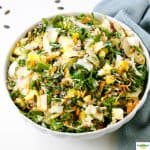




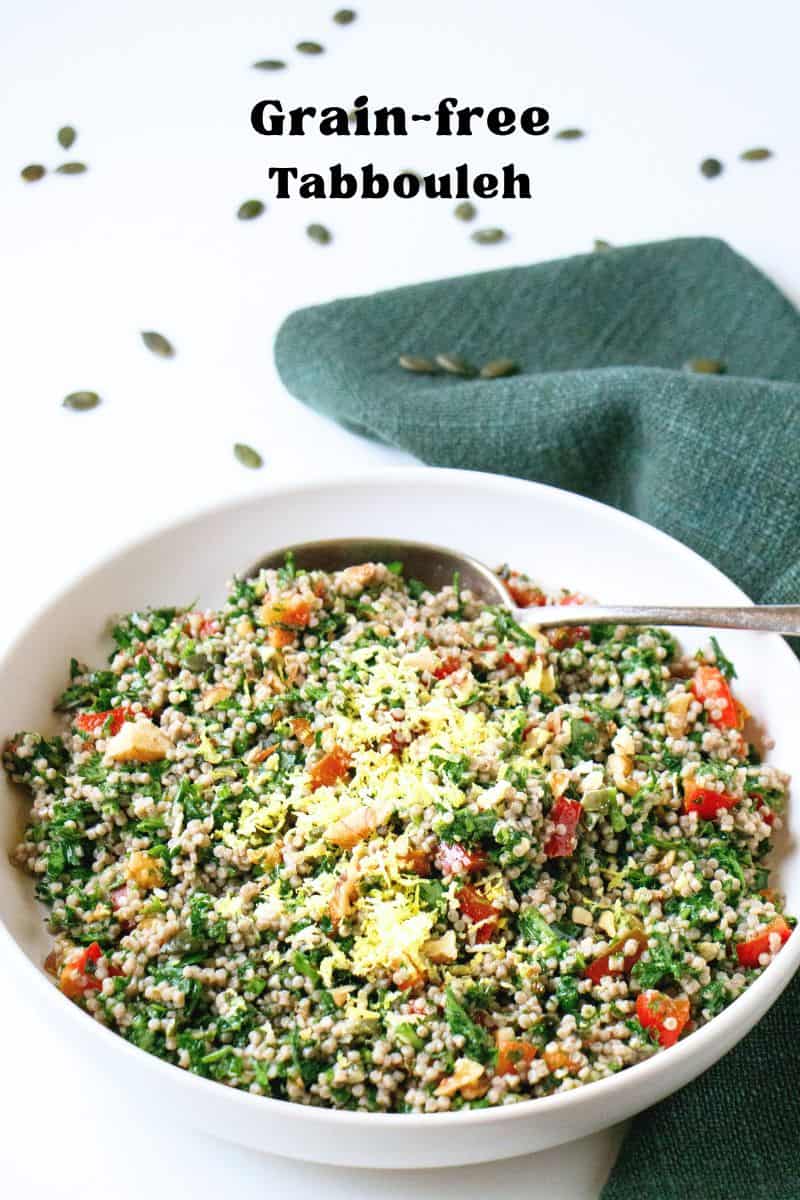
This grain-free green tabbouleh is fresh, crunchy, and bursting with flavor. Arugula and fresh ginger add spicy notes, fresh herbs bring freshness, while walnuts and pumpkin seeds add a satisfying crunch.

But this isn’t just another recipe showing you what ingredients to mix.
I want you to understand what those ingredients are actually bringing to your body.
Because when you know that something as simple as parsley contains powerful flavonoids, that arugula supports your body’s natural detoxification pathways, or that walnuts provide plant omega-3s that support cardiovascular health, you start looking at everyday food differently.
So before we make the tabbouleh, let’s look at what you’re actually putting on your plate.
What Are You Actually Getting From These Ingredients?
🌿 Parsley
Don’t think of parsley as a garnish.
Parsley provides vitamin C, vitamin K, carotenoids, and flavonoids such as apigenin. These nutrients and plant compounds provide antioxidant and anti-inflammatory benefits, support collagen production and bone health, and help protect your cells against oxidative stress.
🌿 Cilantro
Cilantro provides vitamin K, carotenoids, flavonoids, and polyphenols.
These compounds support your antioxidant defenses and healthy inflammatory responses. Coriander has also been studied for its benefits for blood sugar, cholesterol, and cardiovascular health.
🥬 Arugula
Arugula belongs to the cruciferous vegetable family—the same family as broccoli, kale and cabbage.
It contains glucosinolates, which can be converted into biologically active compounds such as isothiocyanates when the leaves are chopped and chewed.
These compounds support your body’s natural detoxification enzymes and cellular defense systems.
Arugula also provides folate, vitamin K, and naturally occurring nitrates that support healthy blood flow.
🌿 Fresh Basil
Basil provides polyphenols and aromatic plant compounds, including rosmarinic acid.
These compounds have antioxidant and anti-inflammatory properties and help protect cells against oxidative stress. Basil has also been studied for its benefits for blood sugar, cholesterol, and metabolic health.
🫑 Bell Pepper
Bell pepper gives you a generous amount of vitamin C, together with carotenoids and other antioxidants.
Vitamin C supports your immune system and collagen production, protects cells from oxidative damage, and helps your body absorb non-heme iron from plant foods.
🌶️ Fresh Red Hot Pepper
That heat comes largely from capsaicin.
Researchers have studied capsaicin for its role in pain signaling, inflammatory responses, circulation, and metabolism.
Fresh chili also provides vitamin C and carotenoids.
🫚 Fresh Ginger
Ginger contains gingerols and shogaols, compounds responsible for many of its antioxidant and anti-inflammatory properties.
Ginger supports digestion and metabolic health and has been studied for reducing inflammatory markers, nausea, and pain.
🌰 Walnuts
Walnuts are particularly interesting because they provide ALA, a plant omega-3 fatty acid, along with fiber, protein, magnesium, and polyphenols.
Regular walnut consumption supports heart health, healthy cholesterol levels and blood-vessel function.
🎃 Pumpkin Seeds
Pumpkin seeds pack a surprising amount of nutrition into a small serving.
They’re rich in magnesium, zinc, iron, protein, and healthy fats, and also contain phytosterols and antioxidant compounds.
These nutrients support energy production, muscle and nerve function, immunity, and cardiovascular health.
🍋 Lemon Juice & Zest
Lemon provides vitamin C and citrus flavonoids that contribute antioxidant protection.
And use the zest!
The peel contains flavonoids and aromatic compounds, so using the juice and zest lets you get more from the whole fruit rather than relying on the juice alone.
🫒 Extra Virgin Olive Oil
Extra virgin olive oil provides oleic acid and polyphenols that support cardiovascular and metabolic health and help regulate inflammation.
It also does something particularly useful in a vegetable-rich meal: fat helps your body absorb fat-soluble carotenoids from the vegetables you’re eating.
Now, Let’s Turn All That Nutrition Into Something Delicious
What makes this tabbouleh recipe unique
What makes this grain-free green tabbouleh so good is its simplicity.
Parsley, cilantro, arugula, and basil create a fresh herbal base. Bell pepper, walnuts, and pumpkin seeds add crunch, while fresh ginger and red hot pepper bring spicy notes.
And here’s what makes the texture awesome: chop your greens very finely.
That’s what transforms a bowl of herbs into something that feels like tabbouleh. It also distributes the different herbs, ginger, and pepper throughout the dish, so you get a little of everything in every bite.
A Simple Lemon & Olive Oil Dressing
The dressing couldn’t be simpler: extra virgin olive oil, fresh lemon juice, and lemon zest.
I keep my dressing simple; feel free to customize it to your liking.
The lemon's acidity brightens the fresh herbs, while the olive oil rounds out the peppery arugula, ginger, and chili.
How to Eat Your Green Tabbouleh
This is what makes this recipe so practical.
You can eat it on its own, add it to bulgur to make a more traditional tabbouleh, spoon it over rice, serve it alongside fish, or pile it onto a good slice of bread; I served mine with quinoa.
And if you don’t like cilantro, don’t let that stop you from making it. Replace it with an herb you enjoy, such as fresh dill.
Try these healthy salads
📖 Recipe
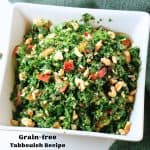
Grain-Free Green Tabbouleh: An Anti-Inflammatory Herb Recipe
Equipment
- A chopping board
- a kitchen knife
- a salad bowl
- A small jar with a lid
- a food grater
- Salad spoons
- A lemon squeezer
Ingredients
- 1 cup parsley
- 1 cup cilantro
- 1 cup arugula
- some leaves of fresh basil
- 1 cup red bell pepper (use any color)
- a small piece of red hot pepper
- a nob of ginger
- a few walnuts
- 2-3 tablespoon pumpkin seeds
Vinaigrette
- 4 tablespoon olive oil
- 2 tablespoon freshly squeezed lemon
- 1 tablespoon lemon zest (organic)
Instructions
Vinaigrette
- Make sure that the lemon is completely dry. Use a food grater to grate the skin. Put the zest in a jar with a lid
- Squeeze the lemon and add the juice to the zest in the jar.
- Add the olive oil. Close the jar and shake vigorously. Set aside.
Tabbouleh
- Clean all the herbs. Use a kitchen cloth to pat dry.
- Chop the herbs very finely
- Dice the pepper into small cubes
- Grate the ginger
- Chop the walnuts and pumpkin seeds
- Bring all the ingredients in a salad bowl. Pour the zesty vinaigrette.
- Using salad spoons, toss the tabbouleh till the vinaigrette is evenly distributed.
- Serve immediately or see the notes below.
Notes
- This tabbouleh has more herbs, and its texture will depend on how finely you chop them.
- While I love eating veggies right away to enjoy all the health benefits, you might find this even tastier and more enjoyable the next day. Make sure to put it in a well-covered bowl to reduce oxidation!
- If you don't appreciate cilantro, feel free to use other herbs like dill.
- I served my tabbouleh with quinoa; you can use baked potatoes, rice, meat/fish, buckwheat, healthy bread, etc.
- Don't use all the vinaigrette.

Comments
No Comments